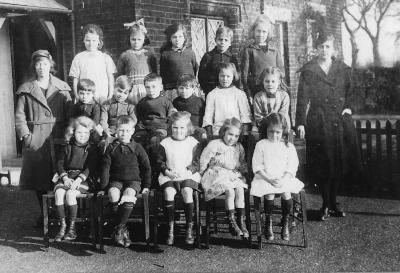
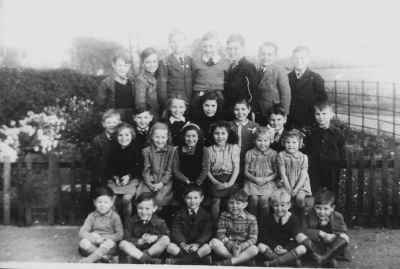
Paglesham School
On the 19th May 1847 Lady Olivia Bernard Sparrow, George Montagu, his wife Millicent and their son William, conveyed to George Murray, Bishop of Rochester, Hugh Chambers Jones, Archdeacon of Essex, and Revd Charles Almeric Belli, Rector of Paglesham Church, a piece of land, part of Punch Bowl Fields in Paglesham, as a site for a National School and schoolhouse, making provision also for the school’s management, through the charities commission.(Essex record office)
It is believed the school was opened in 1849 and by 1881 the population of Paglesham had grown to over 500, with approximately 200 children, although not all of this number attended school or were of school age.
From 1872 the parishioners were asked to subscribe money, (a total of £27 per year) to support the school, as due to the growth and success of the oyster fishing and agriculture farming, more families were re-locating to Paglesham.
The school again needed to expand and by 1894 over 120 children were registered.
This didn’t mean all children attended every day, as often the older male children from 9 years were needed to work with their fathers or help at home. Several of the boys worked in the big houses early morning before going to school, cleaning shoes or collecting wood and coal for the fires.
The only records we have of the teachers from 1851 noting: Eleanor Sexton, Mary Dixon, Eliza Wilkinson and Elizabeth Vince.
In 1899 Mrs Anne Grice Hill was Headmistress and the school attendance was 97 pupils. At this time, sisters Alice (11 years) and Elizabeth Murrell (9 years) lived on Wallasea Island and were brought to school by boat to the Point and then had an arduous walk through the mud and rain over cart tracks, but were noted to ‘attend whenever possible subject to weather conditions’
There are no records of how many staff and helpers were at the school during this time, but anyone who could read or write or sew would have been encouraged to help.
Mr A.Legge was appointed Headmaster and started a log book in 1910 listing 69 pupils. His sister Miss H.A Legge was an assistant teacher and they both lived at the schoolhouse. In his log he mentions how snow and heavy rain would keep children away as they would have to walk over rough unmade tracks but fines would be enforced if children were away from school unnecessarily.
In the register, eight of the children listed, lived on ‘The Beagle’ whilst it was moored as a coastguard vessel in the river.
In 1911 due to the school being small, the children were often allowed out for breaks to play in the field opposite. In February, 5 year old pupil Jimmy Powell ran out and was killed by the first car ever to appear in Paglesham, owned by Mr Brown of Paglesham House. Since this incident the pupils were no longer allowed to play in the field and had to remain in the confines of a small playground attached to the school.
In June 1911 a Coronation mug was presented to every child at the school.
During the First World War a log noted, ‘ About 300 soldiers marched past the school during playtime, creating much excitement, such a sight never having been seen before’.
Fred Farthing is noted in the school ledger as signing up for war, aged only15 years, his older brother Arthur did not return. They were two of ten that signed up from Paglesham.
There are also several mentions of Zeppelins, with three bombs being dropped within a quarter of a mile from the school, meaning closure of the school for a number of weeks.
Mr Legge resigned from the school in 1916, and no permanent Head Teacher was installed until the arrival of Mrs Peacock in 1920. She too, lived in the schoolhouse with her husband and 2 children.
In 1921 the whole school had to be sanitised and closed for 5 weeks due to 11 cases of scarlet fever.
In 1922 Hilda Shuttlewood, a pupil at the school became a pupil/teacher aged 14 and in 1926 passed her Preliminary Certificate for Teaching. She lived with her parents at Glenthorpe, Paglesham Road.
In 1934 free milk became available if the children attended school. There were, by now, two school rooms and a caretaker to light the fires in each room. If however, he was not able to get to the school the pupils were sent home.
During WW11 an unexploded bomb fell close to the school causing it to be closed for over a month.
By 1949 there were only 38 children registered at the school and there was still no tap water, no sewerage and lighting by oil lamps only !

Later this year the Education Authority tried to close the school citing a lack of pupils, but Paglesham fought it and received much support from other small schools in and around Essex.
The school was reprieved, and attendance numbers grew once more.
Both water supply and electricity were laid on by 1951.
We have memories of children who attended the school in the 1940’s through to it’s closure in the 1980’s…..
‘ I remember being brought to Paglesham school when I was about 4 years old and having come from London I was used to seeing much busier places and to start with I hated it. However, I do remember the teacher being a very kind lady, even though I cried every day for the first few weeks. I also remember the toilets having a very uncomfortable seat and a man used to come to the school every evening and carry the buckets out to his cart to clean them and replace them with empty ones.
The school taught many lessons outdoors and I remember long summer days walking along the marshes looking for insects. I also remember dressing up for the pageant which was great fun. The teacher was excellent, I eventually came to love the school, and I was the first pupil of the school to ever pass the 11+ exam’ – Anonymous
Keith Hines was born in 1942 and lived at Church End with his mother Lillian, Dad Ernie and his eleven brothers and sisters. Ernie was a Master Thatcher and Keith recalls his Dad charging £6 to thatch a haystack !
Keith remembers the School Chair of Governors Mrs Meeson, coming into the school each day to call the register, she would arrive in a chauffeur driven Rolls Royce and give each child a chocolate when they answered their name.
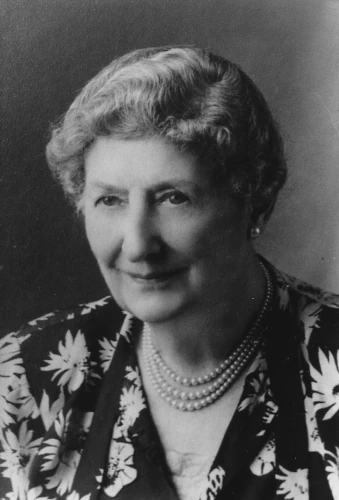
The chauffer driven Rolls Royce would feature in another of Keith’s memories when the car, driven by George Kemp ran over him when he was standing poking a stick into a wasp’s nest ! Luckily he was unhurt as the car passed over him as he lay between the wheels – he was taken home from school early and all was well.
When Keith joined the school in the late 1940’s the Headteacher was Miss Bright, and School Teacher was Miss Palsy. Miss Bright’s sister served as the school’s administrator.
Another child of Paglesham School, Geoffrey Bradley remembers Mrs Meeson always wearing a fox stole !
During the summer months when it was hot and dusty, the boys would walk after school and stop off at South Hall Farm for a ladle of milk straight from the churn. Often they would go scrumping in the orchard and swim or fish in Paglesham Pool.
There was a large pond with willow trees at the end of East Hall Road and the children spent many hours fishing and talking away the hours until it got dark and they headed for home.
Unfortunately the pond no longer exists, having been filled in in the late 1970’s.
Geoffrey Bradley.
Later in the 1950’s Mrs Syme was the Headteacher, Mrs Young was the caretaker and Mrs Keeble was the dinner lady.
The children had a varied education with the school bringing in adults from the village to help.
Daphne Wood to teach drama and the school secretary to teach needlework and patchwork. This was great help for teachers in such a small school.
Further memories …. ‘My days at Paglesham school were the best ! Mr Glynn was the Headmaster and he was very creative and I remember so vividly a puzzle search based on the Golden Hare and we had to find what the riddles meant and then find it within the school.
He organised the school plays and they were so much fun. I don’t remember much actual learning by standard teaching going on, to be honest but I’m sure we must have done schoolwork at some point, and we learned from interaction and lessons outside.
Playtimes were epic with the huge playing field and lots of kiss and chase going on through the tall fir trees !
Tina Thorogood
I attended the school in the 80’s and although I remember very little about the lessons, I do remember one day being left unattended at break time when my brother ran around the table tops which was great fun until he fell and cut his head open on a wooden toy shop that the Headmaster had made.
He had to go to A&E to be stitched up, then he came back to school and that was that ! How things have changed.
I also remember sitting on the floor singing lots of songs, and being taught guitar by Betty Jackson. There was also a quiet corner for sitting and reading.
There was an out of bounds staircase and I remember creeping there quietly with another pupil to play with a ‘slinky’ toy which started at the top and would work its way down the staircase.
We were once taken swimming at Clements Hall and I remember clinging onto the Headmasters back as he swam along !
I don’t think we had to wear a school uniform, as there wasn’t many pupils, and I stayed there until it closed and we were moved to Canewdon School.
Emma Rolph